
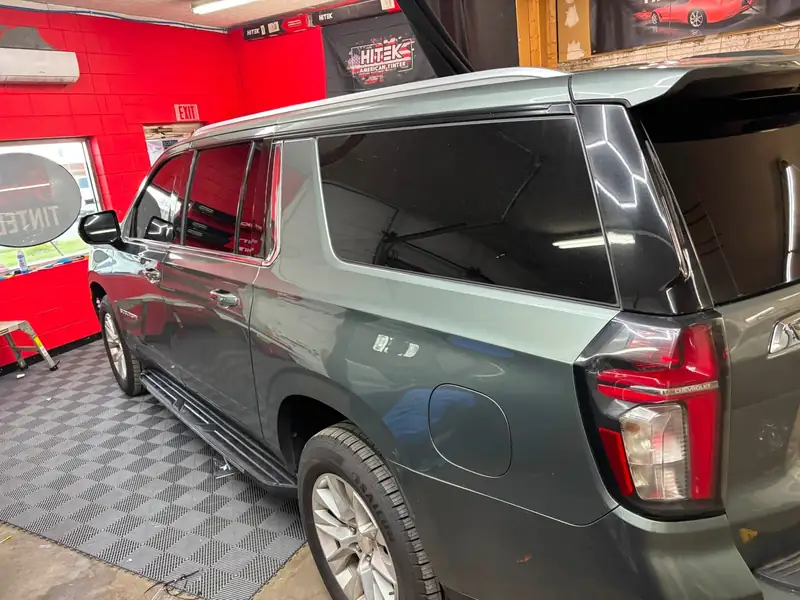
Short answer: Under KRS 189.110, Kentucky allows window film on the front side windows if it lets through at least 35% of light, and on the windows behind the driver if it lets through at least 18%, or 8% on multipurpose passenger vehicles such as most SUVs and vans. The film is rated on clear glass with a 3% tolerance. On the windshield, a strip above the AS-1 line is allowed, and since July 15, 2024, so is film that keeps the windshield at 70% or more. Installers must put a compliance label on the driver’s door jamb.
Kentucky tint limits by window
| Window | Car or truck | SUV or van (MPV) |
|---|---|---|
| Windshield | Strip above the AS-1 line, or clear film that keeps the windshield at 70% or more. Not red or yellow. | Same |
| Front side windows | 35% or lighter, reflectance 25% or less | Same |
| Rear side windows | 18% or lighter, reflectance 35% or less | 8% or lighter, reflectance 35% or less |
| Back glass | 18% or lighter, reflectance 35% or less | 8% or lighter, reflectance 35% or less |
Side and rear limits are for the film tested on 1/8-inch clear glass. Every percentage has a 3% tolerance. A back glass you can’t see through also requires outside mirrors on both sides.
Try a shade
Pick your vehicle and a shade for each part of the car.
Front doors
Rear doors, quarter glass and back glass
35% on the front doors is legal in Kentucky.
20% behind the driver is legal on a car or truck.
Kentucky rates the film itself (tested on clear glass), with a 3% tolerance. Your door-jamb label says MPV if your SUV or van qualifies for 8%. Read KRS 189.110 in plain English
The details, one at a time
Front side windows
The windows beside and in front of the driver need film that lets through at least 35% of visible light, with reflectance of 25% or less, measured from the side without film. Kentucky tests the film on 1/8-inch clear glass, so the light already blocked by your factory glass doesn’t count against you.
Windows behind the driver
Every window behind the driver, including the back glass, needs film of at least 18% with reflectance of 35% or less. On a multipurpose passenger vehicle the limit drops to 8%. Look at the federal label on the driver’s door jamb: it says MPV if your vehicle qualifies. Most SUVs, crossovers and minivans do. Pickups are labeled TRUCK and use the 18% rule.
Perforated window graphics on rear windows have their own rule: at least 30% light transmission, with reflectance limits measured in sections.
Back glass and mirrors
If the back glass is covered with anything you can’t see through, the vehicle needs outside mirrors on both sides. Every modern car has them, but it matters for older vehicles and for heavy rear graphics.
The windshield (changed in 2024)
Senate Bill 46, signed in March 2024, changed the windshield rules. You can have a transparent strip across the top that stays out of the AS-1 area, or film on the windshield that, used together with the windshield’s glass, has light transmission of at least 70% and isn’t red or yellow. Because the glass and film are measured together, very few films pass on most windshields. How we handle windshields.
Tolerance
Every percentage in the law has a tolerance of plus or minus 3 percentage points.
The label
Installers have to give you a permanent label stating the film is compliant, with the film’s trade name and the installer’s business name. It goes on the inside of the driver’s door jamb. If a police officer has a question about your tint, that label is the first thing they’ll want to see.
Penalties
Kentucky treats applying film in violation of the law as a Class B misdemeanor, and the law expects non-compliant film to be removed.
Medical exemptions
KRS 189.110 itself doesn’t include a medical exemption. Ceramic film blocks 99% of UV even at light shades.
Indiana and other states
If you live across the river or just moved here, your current tint was installed under another state’s rules. Indiana and Tennessee measure and limit tint differently.
Sources
- KRS 189.110, Kentucky Revised Statutes (2024)
- 2024 Ky. Acts ch. 17 (Senate Bill 46), effective July 15, 2024
This page explains the statute in plain language. It isn’t legal advice. Last checked October 2026.
Questions we get a lot
What is the darkest legal tint in Kentucky?
35% on the front side windows. Behind the driver, 18% on cars and trucks, or 8% on multipurpose passenger vehicles such as most SUVs and vans.
Is 20% tint legal in Kentucky?
On windows behind the driver, yes. On the front side windows, no: the limit there is 35%.
Is 5% limo tint legal in Kentucky?
No. Even on an SUV or van labeled MPV, the darkest allowed behind the driver is 8%.
Does Kentucky measure tint with the factory glass?
For side and rear windows, no. The law rates the film tested on 1/8-inch clear glass. The windshield rule is different: the film is judged together with the windshield glass.
When did the Kentucky windshield tint law change?
Senate Bill 46 took effect on July 15, 2024. It allows windshield film if the windshield with the film still lets through at least 70% of light.
Do I need a sticker for window tint in Kentucky?
Yes. The installer must put a compliance label on the inside of the driver’s door jamb with the film’s trade name and the installer’s business name.
Is there a medical exemption for tint in Kentucky?
KRS 189.110 doesn’t include one. Ceramic film blocks 99% of UV even at light shades.
Pull up and get shaded.
Most tint jobs are done the same day, and detailing is by appointment. Call, text or send a quote request, and Shane will get back to you during shop hours.