
HITEK Ceramic IR
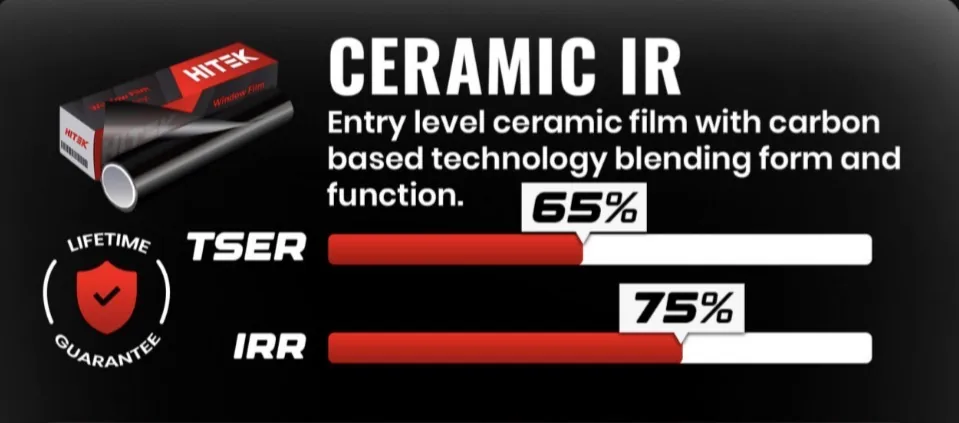
HITEK: “Entry-level ceramic film with carbon-based technology.”
- Solar energy rejected65% TSER
- Infrared rejected75% IRR
- Shades2% to 70%
- GuaranteeLifetime, from HITEK
- Best forMost daily drivers, commuters and leases
full car from $249
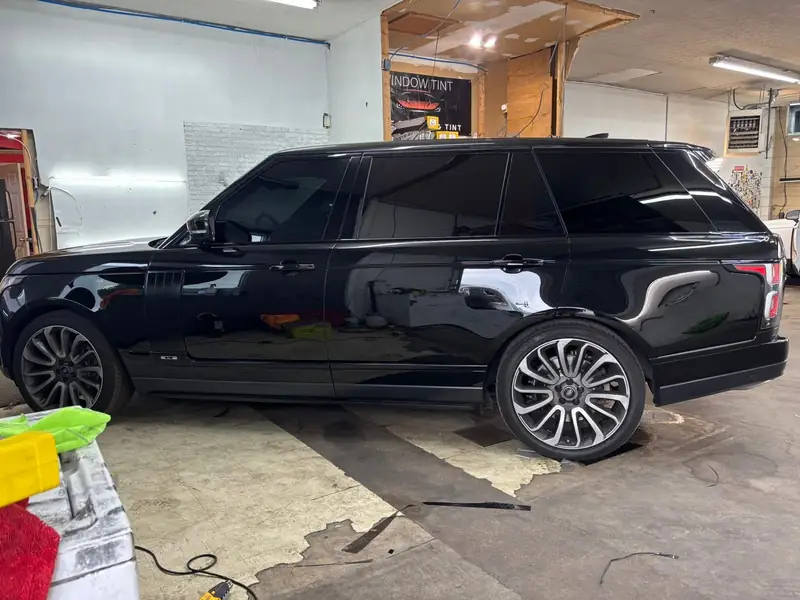
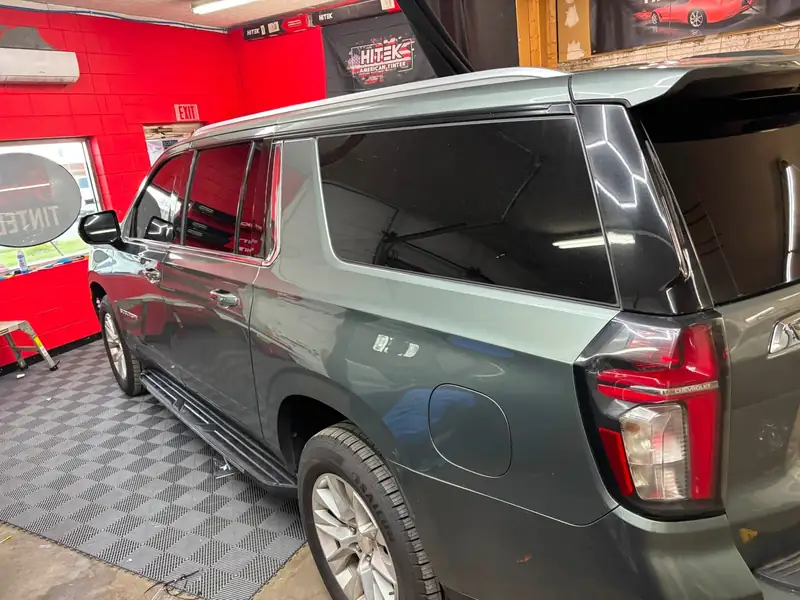
Two HITEK ceramic films with a lifetime guarantee. Here’s the real difference between them and how to pick.
Short answer: Ceramic window tint uses non-metal ceramic technology to block infrared heat, so it keeps a car cooler without blocking phone and GPS signals. 502 Tinted installs two HITEK ceramics: Ceramic IR (from $249 for a car), rated 65% total solar energy rejection and 75% infrared rejection, and Ceramic Plus (from $349), rated 69% and 90%. Both carry HITEK’s lifetime guarantee.
HITEK: “Entry-level ceramic film with carbon-based technology.”
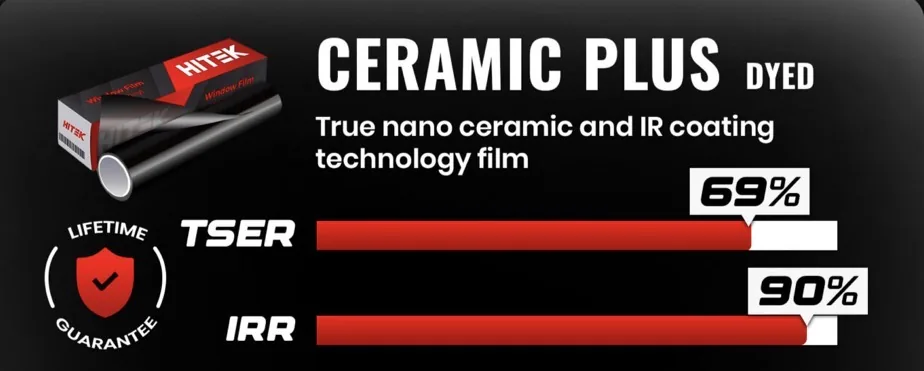
HITEK: “True nano ceramic and IR coating technology.”
| HITEK Ceramic IR | HITEK Ceramic Plus | |
|---|---|---|
| Total solar energy rejected (TSER) | 65% | 69% |
| Infrared rejected (IRR) | 75% | 90% |
| How HITEK describes it | Entry-level ceramic with carbon-based technology | True nano ceramic and IR coating technology |
| UV blocked | Up to 99% | 99% |
| Shades made | 2, 5, 15, 20, 30, 35, 40, 45, 50, 70% | 5, 15, 20, 30, 35, 50, 70% |
| Guarantee | Lifetime, from HITEK | Lifetime, from HITEK |
| Car price at 502 Tinted | from $249 | from $349 |
Sources: HITEK’s spec cards and its Ceramic IR and Ceramic Plus pages. Ceramic Plus numbers are for HITEK’s dyed version, the one we install. They’re lab figures; your car’s glass changes the totals a little.
The heat you feel on your arm through the glass is mostly infrared, not visible light. A dark basic film blocks light but lets plenty of infrared through, which is why a car with cheap limo tint can still be an oven.
Kentucky’s front-door limit is 35%, so you can’t go darker up front to fight the heat. You need a film that blocks infrared at that shade. That’s the whole point of ceramic: a 35% Ceramic Plus front window rejects more solar energy than many dark non-ceramic films.
It works the other way too. If you want a lighter look, a 50% or even 70% ceramic still cuts a noticeable amount of heat.
| Ceramic Plus shade | Light through (VLT) | Solar energy rejected | IR rejected | Glare cut |
|---|---|---|---|---|
| 50 | 50% | 56% | 90% | 45% |
| 35 | 36% | 60% | 90% | 60% |
| 20 | 20% | 65% | 90% | 78% |
| 5 | 6% | 69% | 90% | 93% |
The 35% shade, the darkest legal front-door shade in Kentucky, still rejects 60% of solar energy. HITEK doesn’t publish this table for the 15% and 70% shades.
You want real heat and UV protection at a fair price, your car is a daily commuter, or it’s a lease you’ll turn in. It’s the film most of our customers choose.
Your car sits outside all day, you have a black interior or a big back glass, you drive for work, or you have kids in the back seat in July. The extra infrared rejection is noticeable on hot days.
Some customers put Ceramic Plus on the front doors, where the 35% limit makes heat rejection matter most, and Ceramic IR in back. Ask and we’ll price it.
Text (502) 631-0419 with your vehicle and how you use it, and Shane will tell you which one makes sense. No upsell needed.
For most drivers, yes. Summers here are hot and humid, the front doors can’t be darker than 35%, and ceramic is what blocks the heat without going darker.
Both are ceramic. HITEK rates Ceramic IR at 65% total solar energy rejection and 75% infrared rejection, and Ceramic Plus at 69% and 90%. Ceramic Plus costs more and blocks more heat.
No. Ceramic film has no metal layer, so phone, GPS, radio and key fob signals pass through normally.
Yes. HITEK rates Ceramic Plus at its light 50% shade at 56% total solar energy rejection and 90% infrared rejection.
The life of the car, under normal use. Both films carry HITEK’s lifetime guarantee.
Most tint jobs are done the same day, and detailing is by appointment. Call, text or send a quote request, and Shane will get back to you during shop hours.